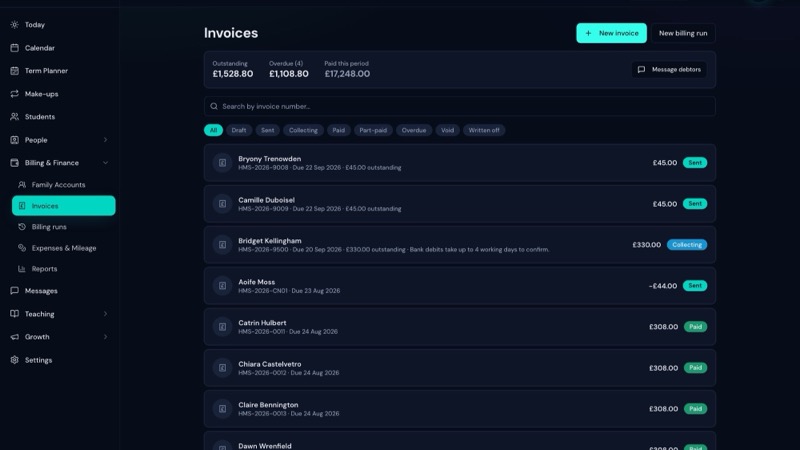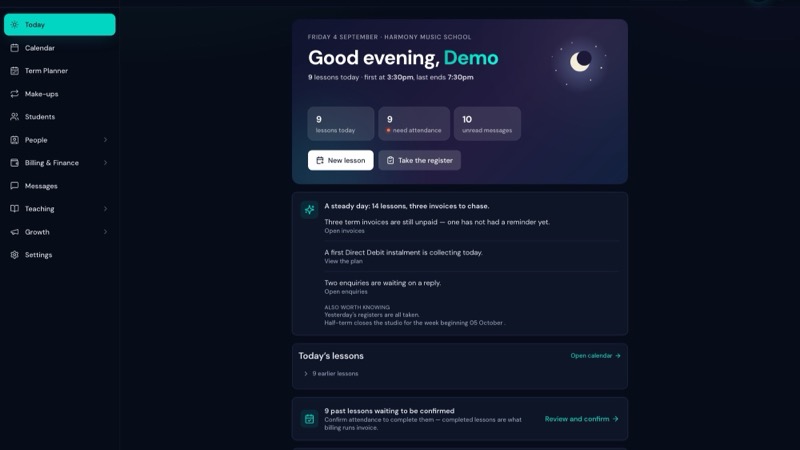
A UK music school collects termly fees by Bacs Direct Debit through its payments provider. The parent sets the mandate up themselves, because a Direct Debit is the payer's authority; invoices and instalments are then collected as they fall due. Bank debits take up to four working days to confirm, and the Guarantee requires 10 working days notice of a change.
Chasing termly fees is the most disliked job in a music school and the easiest to remove. This is how Direct Debit actually works, what it does not solve, and what to do when one fails.
Why Direct Debit rather than a card
A card payment needs someone to decide to pay. A Direct Debit does not.
That difference compounds across a school. Thirty families paying by card in September means thirty decisions, four reminders each, and a tail of three who need a phone call in November. Thirty families on Direct Debit means a collection date.
Two smaller advantages worth knowing. Direct Debit is usually cheaper to process than a card for the same amount, and it does not expire — a card is reissued every three years, and each reissue is a small pile of failed payments in a school that stores them.
How a mandate actually works
Only the payer can create it. A Direct Debit is the payer’s authority to take money from their bank, so there is no way — and there should not be — for a school to set one up on a family’s behalf. What you can do is make it easy: put it in front of them where they already look, which is the invoice.
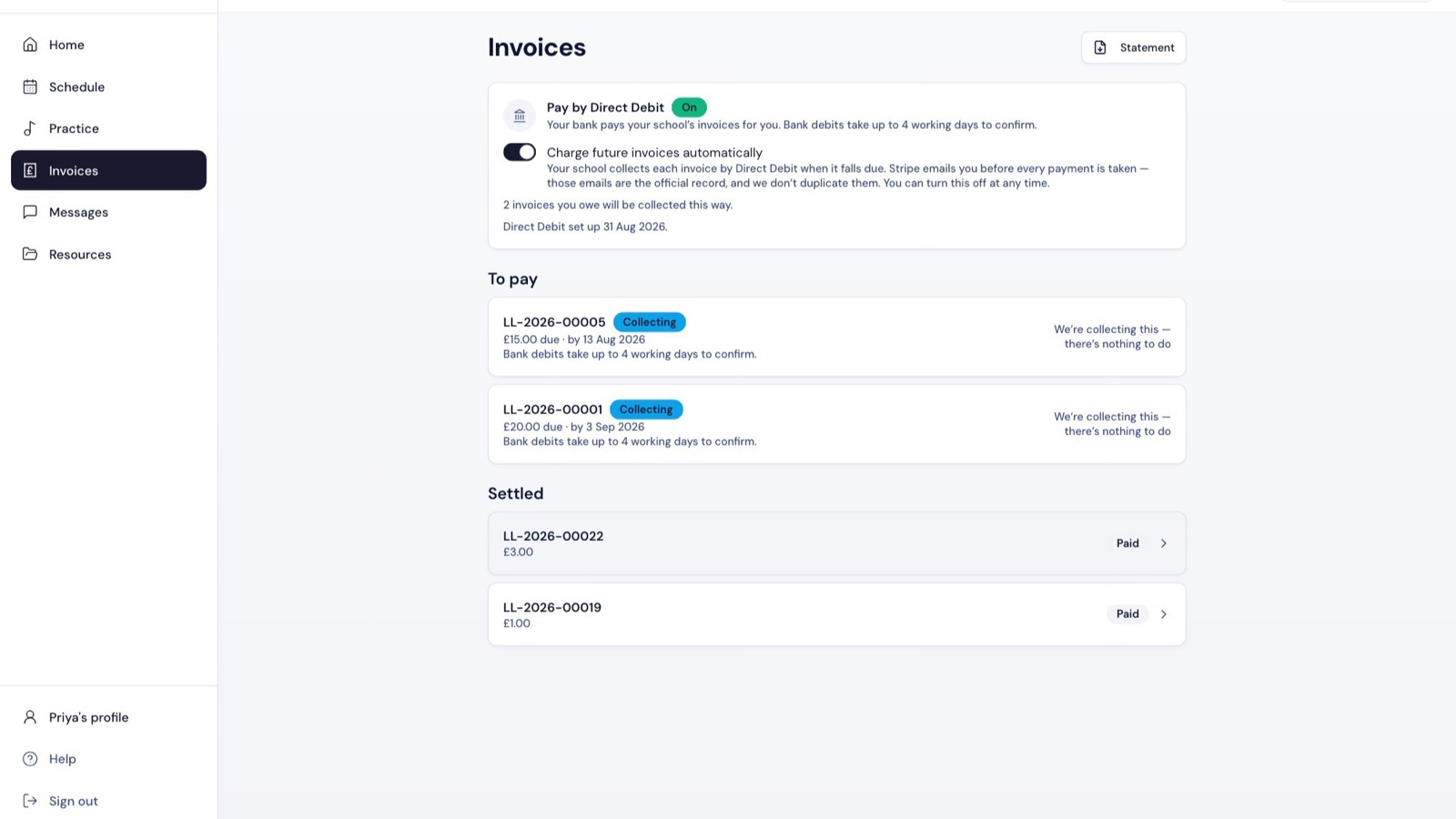
In LessonLoop that is the parent portal’s Invoices page, where a Direct Debit card sits at the top with three states:
- Empty — no mandate yet, and the consent step that hands off to Stripe to collect the bank details.
- Active — a live mandate, with an autopay switch.
- Revoked — the mandate was cancelled, named plainly as cancelled, with the way to set a new one up.
The legal notices come from your payments provider. The mandate confirmation and the advance notice of each debit are issued by them, not by your school. That matters, because those notices are what the Direct Debit Guarantee requires.
The Direct Debit Guarantee
Every Direct Debit in the UK carries it. Direct Debit is owned and managed by Pay.UK Limited, the recognised operator of the UK’s interbank retail payment systems, and the Guarantee is the reason parents trust the instruction at all. Three parts matter to a school:
- Advance notice — normally 10 working days — of any change to the amount, date or frequency of a collection.
- A full and immediate refund from the payer’s bank if an error is made by the organisation or the bank.
- It does not change the underlying agreement. A parent who claims money back still owes it under your terms of teaching. The Guarantee is a payments protection, not a way out of a contract.
The practical consequence: do not surprise anybody with an amount. If a term’s fee is different from the last one, the notice has to go out before the collection does — which your provider handles, but which is also a reason to issue invoices well ahead of the term rather than the week it starts.
The four working days
While a debit is on its way, the invoice is collecting — not paid, not failed.
“Bank debits take up to 4 working days to confirm.”
That is the bank’s timetable, not a delay in your software. Two things follow, and both cause real accounting mess when they are ignored:
- Do not record a manual payment against a collecting invoice. When the debit clears you will have counted it twice.
- Leave collecting families out of the reminder ladder. A family who has done exactly what you asked should not get a chasing email while their money is in flight. In LessonLoop the reminder ladder skips them automatically.
Plan the collection date backwards from when you need the money, not forwards from when you issue the invoice.
Termly, monthly or instalments
Direct Debit works with all three, and the choice is about the family:
- Termly in advance — one collection per term, per pupil. Funds the term before you teach it, and is the simplest to reconcile.
- Monthly rolling — the annual fee divided by twelve, collected on the same day every month including August. Easiest for families to budget, and it smooths your own year.
- A payment plan — one termly invoice split into instalments, each collected on its own due date. The middle option, and the fix for the January invoice that arrives in the same week as everything else.
→ Music lesson pricing models compares all five models on cash flow, missed lessons and admin.
When a debit fails
Debits fail: a closed account, insufficient funds, a cancelled mandate. What matters is what happens next.
In LessonLoop the failed instalment is parked rather than quietly dropped, and it is named on the invoice. You open the invoice, find Parked collections, and choose Resume collection when you are ready. Nothing is re-presented to a bank automatically — a school should decide that, not a background job.
Then it is a conversation with one family about one invoice, rather than a number at the end of the term that nobody can explain.
Late fees, applied evenly
A late fee is only fair if everybody knew about it. Set the reminder ladder — how many days after the due date each nudge goes out — and the optional late fee in one place, studio-wide, and let it run. Every reminder should carry a pay link, because a family should never have to hunt for the invoice they are being reminded about.
And there should be a pause switch, for the week when a family has had bad news and you want everything to stop.
What you need to start
- A payments provider with Bacs access. Collecting through Stripe means you do not need your own Bacs service user number, bank sponsorship or an approved bureau.
- Your own account, not your software’s. Money should land in a payment account in your name. LessonLoop connects your own Stripe account and adds nothing on top of standard Stripe rates.
- Somewhere for parents to set the mandate up. The invoice they are already looking at is the right place.
- A published fee schedule and a cancellation policy, so the amount is never a surprise.
- A reminder ladder and a late-fee rule you apply to everybody.
Doing it in LessonLoop
Bacs Direct Debit and card payments into your own Stripe account. Families set their own mandate up from the portal and switch autopay on. Invoices and payment-plan instalments are collected as they fall due; collecting invoices sit in their own tab; failed collections park and wait for you; the reminder ladder leaves Direct Debit families alone while a collection is in flight; and automatic late fees run on your own rule.
£39 a month, flat — unlimited teacher accounts and pupils. Music school software · performing arts schools · the whole billing picture
Sources
- Direct Debit, the Direct Debit Guarantee — the 10 working days notice, the refund entitlement, and Pay.UK Limited as operator; checked 4 September 2026
- LessonLoop help centre, get paid by Direct Debit — the four-working-day confirmation, the mandate states and parked collections
Related reading
- Music lesson pricing models — termly, monthly, packs and hybrids compared
- Music lesson cancellation policies — the document that decides what a missed lesson costs
- Running a UK music school, end to end — the whole operating cycle