A UK music school runs on eight recurring jobs: set the teaching year, enrol families, take registers, invoice termly, collect the money, handle absences by policy, pay teachers, and keep parents informed. The year is roughly 36 to 38 teaching weeks against the schools' 39. Do those eight well and the school runs itself.
This is the whole operating cycle, in the order it actually happens, with the detailed guide for each part linked underneath it. If you are starting from nothing, read it top to bottom once; if something specific is broken, jump to that section.
1. The teaching year
Everything downstream is built on this, and most schools get it slightly wrong.
A UK state school year is 195 days — 190 teaching days plus five INSET — packed into roughly 39 weeks. Most private studios teach 36 to 38, starting the week after schools return and finishing before the Christmas concerts. Scotland runs about 38 from a mid-August start; Northern Ireland runs early September to around 30 June.
Two traps. First, over 150 English local authorities set their own dates, academies can diverge from their own council, and Easter alone swings term boundaries by up to two weeks — so if you teach across three schools in two authorities you can face three different half-term weeks. Check every venue, every year.
Second, almost every English bank holiday is a Monday. The Monday pupil gets two to three fewer lessons a year than the Wednesday pupil before anyone is ill. If every weekday pays the same flat termly fee, your Monday families are subsidising the rest, and eventually one of them counts.
→ How many teaching weeks are in a UK school year? · The free term date planner
2. Enrolment and families
An enquiry that lands in an inbox is a place you have already half lost. Give enquiries somewhere to live — a form on your own site, a booking page for taster slots — and track them through to an outcome rather than to a memory.
Then, at enrolment, hand the family three things at once: the fee, the term dates, and the cancellation policy. Every argument you will have in March is caused by one of those three not being given in September.
One family, one account. Three children across four activities should produce one balance, one statement and one conversation — not four invoices, four chases and a parent who reasonably asks why.
3. Registers and absence
The register is the most important five seconds in the whole cycle, because everything downstream is built from it.
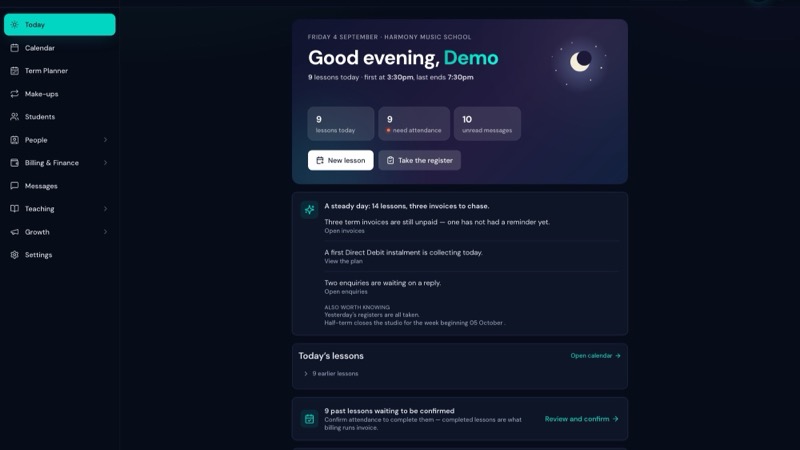
Mark it in the room, on a phone, one tap per pupil, with the absence reason attached. Then let that one mark produce the invoice line, the make-up credit and the teacher’s pay. The moment attendance lives in three places, every term ends in reconciliation.
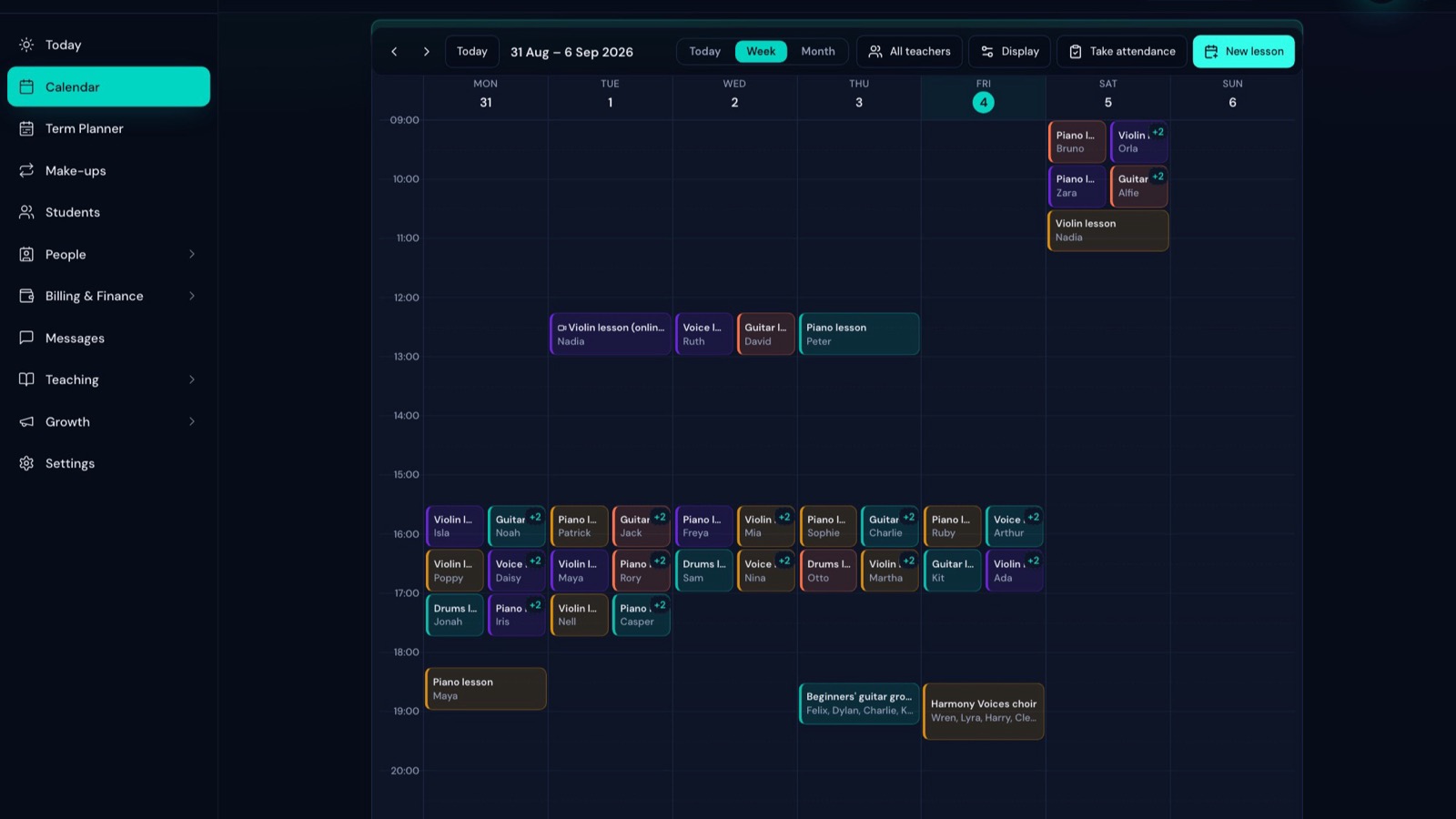
If you teach inside partner schools where the office sends children out one at a time and there is no fixed clock time, you need registers that work that way — one block per school, per teacher, per day, with a running order you can rearrange — rather than a timetable of invented times.
4. Termly fees, and getting paid
Choose a pricing model deliberately rather than inheriting one. Termly in advance funds the term before you teach it and is the simplest to reconcile; monthly rolling — the annual fee divided by twelve — is easier for families to budget and survives August.
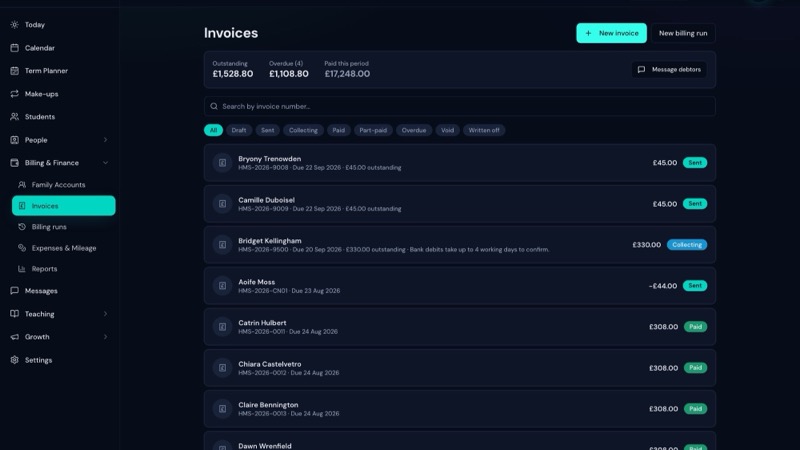
Whichever you pick, the mechanics are the same: generate the invoices from the lessons already on the timetable, preview the run before it issues, send from your own address on your own domain, and give families a way to pay that does not require them to remember.
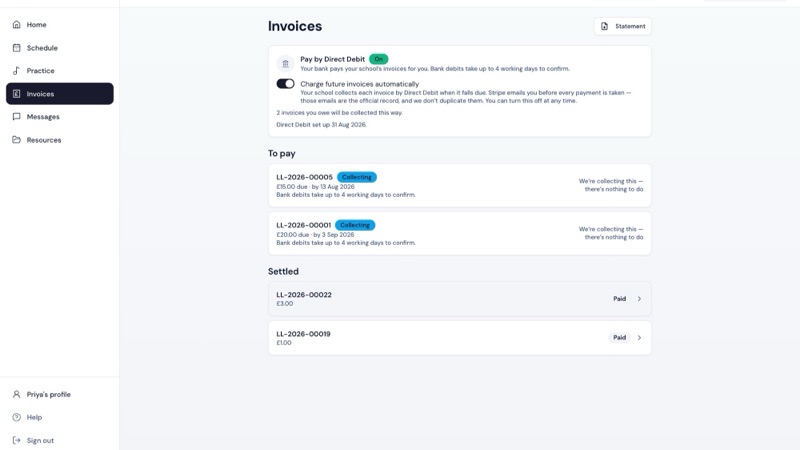
Bacs Direct Debit is the one that removes chasing entirely for the families who take it. The parent sets the mandate up themselves — a Direct Debit is the payer’s authority, so no school should be able to create one on their behalf — and after that invoices and instalments are collected as they fall due. Bank debits take up to four working days to confirm, and a family being collected from should be left out of your reminder ladder while a collection is in flight.
→ Music lesson pricing models · Collecting fees by Direct Debit
5. Make-ups and cancellations
The policy is the product here, not the software. Decide six things once — the notice you require, which absences earn a make-up, whether that is a credit or a rebooked slot, how long a credit lasts, how many a pupil may earn in a term, and what happens to unused lessons — write them down, give them to families at enrolment, and apply them to everyone.
A policy is not strictness. It is the same answer for everybody, decided when nobody is upset, so the awkward conversation is with a document rather than with you.
→ Music lesson cancellation policies · The free make-up policy generator
6. Hiring and paying teachers
Set a pay basis per teacher — per lesson, hourly, or a percentage of what the lesson earns — with a rate, a default lesson length, and whether you engage them as an employee or a self-employed contractor. Add exceptions where a particular kind of work pays differently.
Then pay from the lessons that were actually taught. A payroll report built from the register reconciles to the teaching; a payroll spreadsheet maintained beside it does not, and the difference shows up in March.
Access matters as much as pay. A teacher should see their own teaching and their own pupils, and nothing else; whoever does your finance should see invoices and family accounts and not private messages. Roles that shape the whole sidebar are calmer than roles that let people click things that then refuse.
7. Parents
The parent relationship is where retention actually lives, and it is mostly about not making people ask.
Give every family one login for this term’s schedule, every invoice, their Direct Debit and their messages, at your own web address rather than a supplier’s. Send from your own email address, with consent recorded and delivery status visible per family, so a closure notice is something you can confirm arrived.
The measure is simple: how many “what time is the lesson?” messages arrive in a week. If the answer is more than a couple, the portal is not doing its job.
8. The records underneath it
HMRC requires self-employed records to be kept for at least five years after the 31 January submission deadline of the relevant tax year, so a school is holding roughly six years of paperwork at any moment. From 2024/25 cash basis is the default, and Making Tax Digital adds digital records and quarterly updates from 6 April 2026 above £50,000 of qualifying income.
The practical version: one place for income, a separate business account, and mileage logged as it is driven.
→ Record keeping for UK music teachers · Making Tax Digital for music teachers
The whole guide
Everything above, in full:
- How many teaching weeks are in a UK school year? — 195 days, 36–38 for a studio, and the Monday problem
- Music lesson pricing models — the five models and what each one costs you
- Music lesson cancellation policies — the six decisions, and a free generator
- Collecting music lesson fees by Direct Debit — Bacs, mandates and failed payments
- Record keeping for UK music teachers — what to keep, and for how long
- Making Tax Digital for music teachers — thresholds, dates and quarterly updates
- How music education works in the UK — hubs, exams and where private teaching sits
- Music lesson prices UK 2026 — what to charge, by instrument
And the free tools, none of which asks for an email: term date planner · make-up policy generator · admin cost calculator · software cost calculator
Doing all eight in one place
That is what LessonLoop is. Terms and closures set once and applied to every teacher; registers marked on a phone that feed invoicing, make-up credits and payroll from one record; billing runs generated from the timetable; Bacs Direct Debit, payment plans and automatic late fees; family accounts that reconcile; thirteen reports; and a parent portal on your own domain. £39 a month, flat — unlimited teacher accounts and pupils.
Music school software · multi-site academies · performing arts schools · what it costs against the alternatives
Still the only teacher on the timetable? The single-teacher version of all of this is music teacher software at £15 a month, and everything moves across to the School plan the day you hire.