Teaching music privately in the UK needs no qualification, degree or registration. It needs four things: a rate worked backwards from the income you want, an Enhanced DBS check, public liability insurance at roughly £40–£90 a year, and a written policy. Register with HMRC once gross income passes the £1,000 trading allowance; the return is due 31 January.
The teaching is the part you already know. This is the other half — the part that decides whether a full diary turns into a living — with the detailed guide for each piece linked underneath.
1. What to charge
Typical UK rates in 2026 with a qualified private teacher: £15–£32 for 30 minutes and £28–£65 for an hour, varying by instrument, region and experience. Piano runs £18–£30 a half hour, guitar and drums £15–£28, singing £18–£32. London and the South East run 20–40% above those ranges. The Musicians’ Union publishes a recommended hourly rate, updated annually, that acts as a floor for professional qualified teaching.
But copying a local rate is how most teachers end up underpaid. The rate is an output, not an input:
Income = rate × teaching hours a week × teaching weeks × utilisation − costs
Two of those four are where people go wrong. Teaching weeks are 36–38, not 52 — the holidays are unpaid, and a rate calculated on a full year is roughly 30% short. And utilisation is never 100%: a slot that is empty in November earns nothing, and your rate has to carry it.
→ Music lesson prices UK 2026 · How much do music teachers earn? · The free hourly rate calculator
2. Getting paid
The difference between a profitable teaching business and a stressful one is rarely the rate. It is whether the money arrives without you asking.
Three things do most of the work:
- Invoice in advance, for the term or the month, not after the teaching.
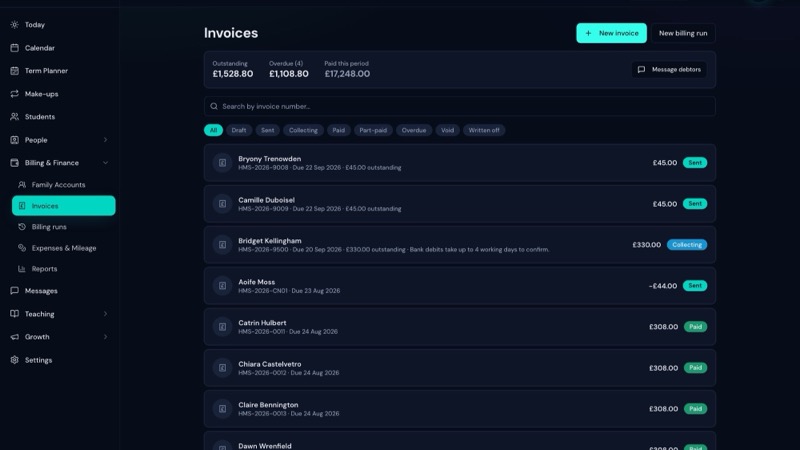
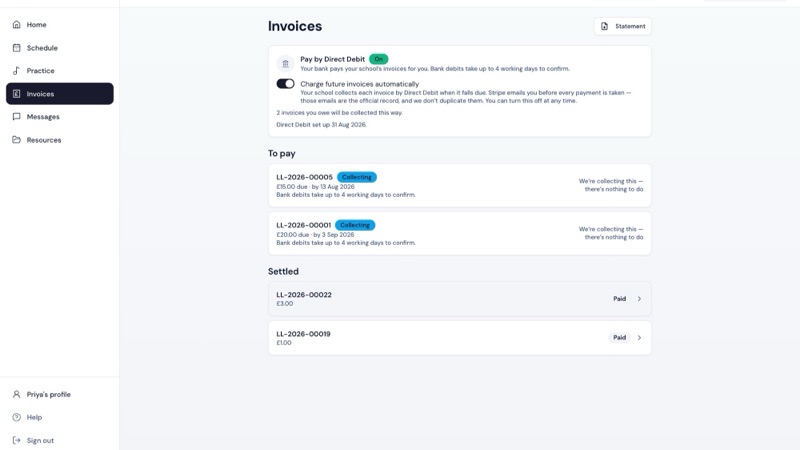
- Give parents a way to pay that does not need remembering. Bacs Direct Debit is the one that ends chasing entirely: the family sets the mandate up themselves, and after that invoices and instalments are collected as they fall due. Bank debits take up to four working days to confirm.
- Have a late-payment rule and apply it evenly. An automatic late fee that everyone knew about is a policy; an inconsistent one is a negotiation.
Where the money lands matters too. Payments into your own payment account are yours as soon as they clear; payments held by a platform and paid out weekly are a loan you are making to your software.
→ Music lesson pricing models · Collecting fees by Direct Debit
3. The tax year
If you teach privately and are not taxed through an employer’s payroll for that work, you are self-employed for it — even if you also have an employed job, which most peripatetic teachers do.
- The £1,000 trading allowance. Below £1,000 of gross self-employed income you generally do not need to register or file. Above it, you register for Self Assessment.
- The dates. The tax year runs 6 April to 5 April. Register by 5 October after the tax year you started. The online return and the payment are due 31 January. If your bill tops £1,000, HMRC also wants payments on account on 31 January and 31 July.
- Set aside 25–30% of profit as a planning rule, and refine it once you have seen a real year.
- Mileage is 45p a mile for the first 10,000 business miles and 25p after, or actual costs proportioned to business use. Keep a log: date, from, to, miles, purpose.
- Records must be kept at least five years after the 31 January deadline. From 2024/25 cash basis is the default.
- Making Tax Digital brings digital records and quarterly updates from 6 April 2026 above £50,000 of qualifying income, 6 April 2027 above £30,000 and 6 April 2028 above £20,000.
→ Self Assessment for music teachers · Making Tax Digital · Record keeping
4. DBS and safeguarding
Teaching children one-to-one on a regular basis is regulated activity, and the right check is an Enhanced DBS with barred-list information. A Basic check cannot see the barred list at all.
The important change: since 21 January 2026 self-employed workers in eligible roles can obtain an Enhanced check in their own name, through a registered DBS umbrella body, with no employing organisation needed. Before that a self-employed teacher legally could not. Any guide that still says otherwise is describing the old rules.
Register the certificate with the DBS Update Service the day it arrives — the registration window from issue is short, and it turns a snapshot into something anyone you authorise can verify online. Scotland uses PVG through Disclosure Scotland; Northern Ireland uses AccessNI.
Beyond the certificate: a short children’s-workforce safeguarding course, lessons structured for visibility, and all communication routed through parents.
→ DBS checks for music teachers
5. Insurance and membership
Public liability is the minimum, at roughly £40–£90 a year as a standalone purchase — or effectively included with membership of the Musicians’ Union or the ISM, both of which also bring contract templates, legal advice and the recommended-rates benchmark. For most teachers, joining one of the two is the simplest way to get insurance, credibility and backup in a single move. Instrument insurance is a separate policy and worth it if your instrument is your livelihood.
6. The policies you write once
Three documents, written before you need them, prevent most of the difficult conversations of a teaching career:
- A cancellation and make-up policy. Six decisions: notice, which absences earn a make-up, credit or rebooked slot, how long it lasts, how many a term, and what happens to unused lessons.
- Terms of teaching. Fees, when they are due, notice to leave, and what happens in the holidays.
- A privacy note. What you hold about a child, why, and for how long — short, plain and given at enrolment.
→ Music lesson cancellation policies · The free make-up policy generator
The whole guide
- How to become a private music teacher in the UK — the route in, with no PGCE
- Music lesson prices UK 2026 — what to charge, by instrument
- How much do music teachers earn? — classroom, peripatetic and private compared
- Self Assessment for music teachers — expenses, deadlines and MTD
- Making Tax Digital for music teachers — thresholds and dates
- DBS checks for music teachers — which check, and the January 2026 change
- Music lesson cancellation policies — the document that ends the arguments
- How many teaching weeks are in a UK school year? — the number every fee depends on
Free tools, no email gate: hourly rate calculator · term date planner · make-up policy generator · admin cost calculator
The software half
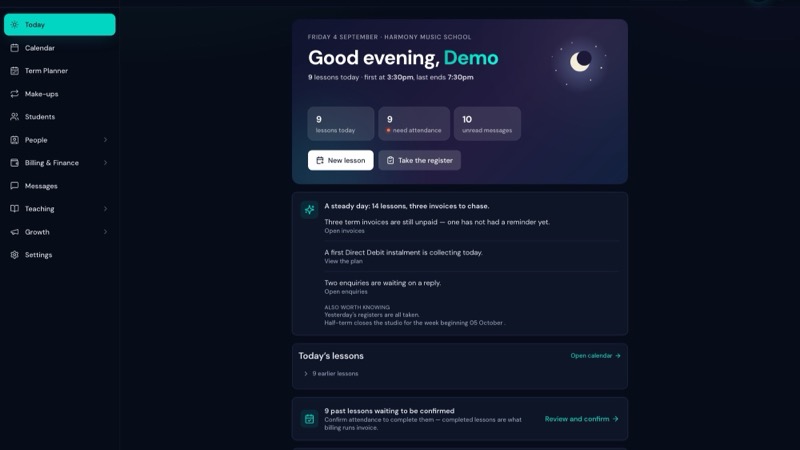
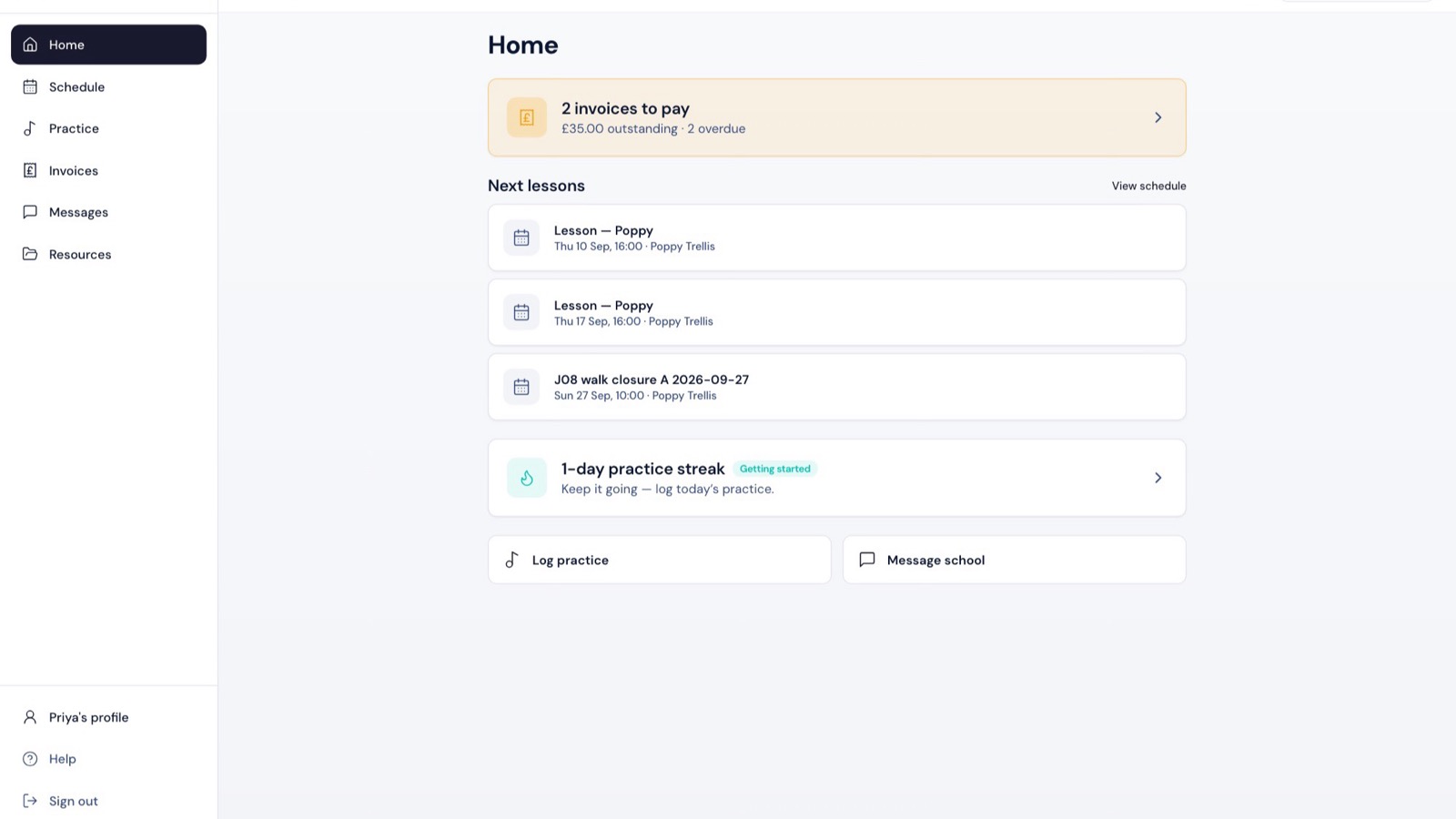
Your diary, registers, lesson notes, automatic invoicing and parent messaging in one place, with parents paying by card or Bacs Direct Debit into your own Stripe account — LessonLoop adds nothing on top of standard Stripe rates. Expenses and mileage kept against the UK tax year. A parent portal on your own domain. A native iPhone app for the register. £15 a month, unlimited pupils, with a 30-day trial and no card.
Music teacher software · compared with the alternatives · run the cost yourself
When you take on your first teacher the shape of the work changes — timetables to share, pay rates to set, payroll to run. That is music school software at £39 a month, with unlimited teacher accounts.